
Airless Bottle Height: The Cap Takes a Third of It
When a catalogue gives one height for an airless bottle, it usually gives the total: cap on, ready to pack. That is the number the carton and the freight quote care about. It is not the number the label cares about, and it is not the number your filling line sees. Airless bottle dimensions are usually published as that one figure, which is why the second figure is easy to miss.
Across the 39 airless bottles in this collection, 38 print both the total height and the cap height. In those 38, the cap accounts for a median 32% of the total, and the share ranges from 18% to 47%. The body is the rest, but it is not simply total minus cap, because the cap overlaps the body on most of these packs.
Airless bottle height is two numbers, not one
The catalogue prints the total height as the headline figure, because it is the dimension that decides whether the pack fits a shelf, a carton and a courier box. The body height is printed in the same table, but it is easy to skip when you are scanning for a size. Airless bottle height, then, is two measurements printed in one row, and the one you need depends on what you are fitting.
That is a mistake if the pack has to carry a label. A tall cap can make a short bottle look tall in a line-up and leave very little flat surface for print. Two packs with the same total height can offer very different bottle label areas.
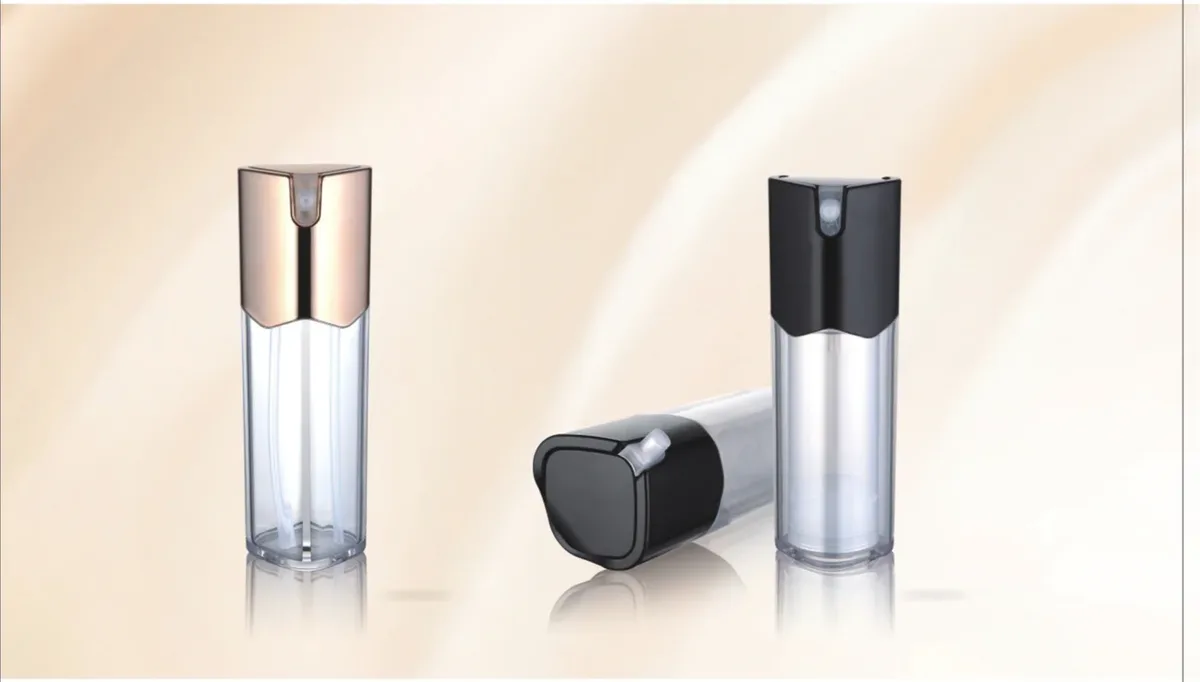
What the cap hides
Of the 38 bottles that print both figures, the cap is 18% of total height at the low end and 47% at the high end. That is a wide range for packs that all sit under the same product heading. The difference comes from cap architecture: a flush overcap, a tall domed cap and a dropper collar all cover different amounts of the body. Cosmetic bottle cap height is therefore a design choice, not a fixed ratio.
There is no good or bad share here. A tall cap can be the design idea, and a low cap can maximise the printable body. The point is that the total height does not tell you which one you are looking at. If your brief says "under 130 mm" and stops there, you have constrained the carton but not the label.
The pair that shows the problem
Two 30 ml airless bottles in the range make the difference concrete. One is a cylindrical pack with a total height of 121.7 mm, a body height of 75.5 mm and a cap of 28.2 mm. The other is an oval side-stand pack with a total height of 122.5 mm, a body height of 89.5 mm and a cap of 57.4 mm.
| 30 ml format | Total height | Body height | Cap height |
|---|---|---|---|
| Cylindrical airless bottle | 121.7 mm | 75.5 mm | 28.2 mm |
| Oval side-stand airless bottle | 122.5 mm | 89.5 mm | 57.4 mm |
| Difference | 0.8 mm | 14.0 mm | 29.2 mm |
The totals are within a millimetre. The bodies differ by 14 mm, which is roughly the height of a three-line label block. A brief that specifies only the total would treat these two as the same size. They are not.
Note also that the body and cap figures do not add up to the total. The cap sits over the body on these packs, so the three numbers overlap. Do not use the table to calculate one field from the other two. Use each as printed.
What to put in a height brief
| Ask for | What it controls |
|---|---|
| Total height, cap on | Carton fill, shelf fit and courier limits. |
| Body height | Label area and the proportion you see on shelf. |
| Cap height, separately | Tells you whether the total is mostly bottle or mostly closure. |
| Maximum diameter | Label wrap, shelf depth and the filling line's change parts. |
| Fill height, if the supplier prints or measures it | The filling line needs the height of the fill, not only the pack. |
| A sample of both candidate formats | The three dimensions do not show how the pack sits in the hand. |
If your constraint comes from a retailer or a courier, give the total height and say so. If it comes from a label or a filling line, give the body height and the fill height. If it comes from both, give both numbers and ask the supplier to confirm which format meets each one. A single "height" in a brief invites a quotation that meets one constraint and misses the other.
Where the measurements come from
The formats are published on the airless bottles and cream jars page and the bottles and jars page, with the total height, maximum diameter and material the source prints. The body and cap heights come from the same source table and are shown on the format cards where the source provides them. The counts and the paired example are taken from the formats published on the airless and bottles pages, so each figure can be checked against the catalogue.
The range is one manufacturing partner's catalogue, and every format in it is made to order. We quote per project rather than from a stock list, and order quantity is confirmed project by project. If airless packaging size is part of your brief, send the total height limit, the body height you need for the label, and the fill height your line runs. We will tell you which formats meet all three, and where a sample is the only way to confirm the fit. Start an enquiry →