
Skincare Packaging Sets: Why 56 of 133 Formats Are Bottle-and-Jar Pairs
A skincare catalogue is rarely a list of single packs. It is a list of routines. Skincare packaging sets in this 133-format catalogue are the default, not the exception: 56 entries are named as sets, and most of those pair a lotion or airless bottle with a cream jar in the same shape and finish. The photographs show the pair together. The specification line often shows two capacities, one for each part.
That layout is useful for a brand launching a range, and easy to misread in a quotation. A cosmetic packaging set in a catalogue is a merchandising unit. It is not automatically one SKU, one carton or one price line.
Skincare packaging sets: what the 133 formats contain
| Section | Formats | What it holds |
|---|---|---|
| Lotion Bottle & Cream Jar Sets | 38 | Bottle and jar shown as one family |
| Airless Bottle & Cream Jar Sets | 15 | Airless bottle and jar, matched finish |
| Airless Bottles | 43 | Bottle only |
| Cream Jars | 12 | Jar only |
| PET Bottles | 9 | Bottle only |
| Deodorant Sticks | 8 | Stick format |
| Refill Bottles & Jars | 6 | Refill construction |
| Lotion Bottles | 2 | Bottle only |
The set sections are not a small add-on. They account for 53 of the 133 formats, and the refill section adds six more. The rest of the book is the individual packs those sets are built from.
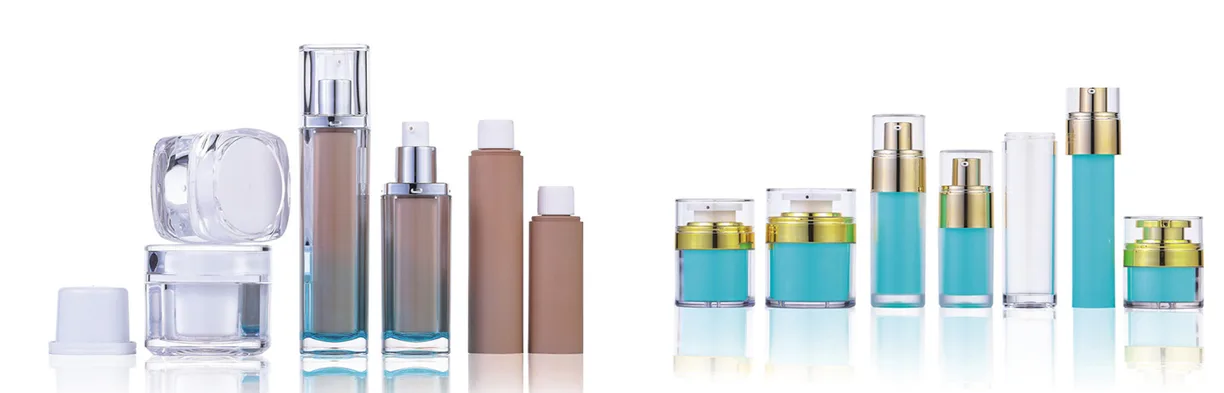
The two-part capacity line, and why ml and g do not meet
Forty-nine of the 133 entries print both capacities on one line. A typical line reads 15 / 30 / 50 / 80 / 120 ml · 15 / 30 / 50 g. The first group is the bottle, measured by volume. The second is the jar, measured by the weight of product it is designed to hold.
Those numbers are not two views of the same quantity. A 50 g jar and a 50 ml bottle do not hold the same amount of anything until you know the density of the product going into each. A light cream and a dense balm will fill the same jar at different weights. The catalogue prints the figure the factory uses for that part, and it does not print a density.
This is where a quotation can look comparable and not be. If one supplier quotes a jar by grams and another by millilitres, you are not comparing like with like. Ask each to state the unit and the fill rule behind it.
A set is a photograph before it is an order line
The catalogue groups a bottle and a jar because they share a design language: same cap profile, same collar, same colour direction. A cream jar and lotion bottle that sit together on a shelf should look like they were specified together, and here they often are. That is a real advantage. It does not tell you how the factory will price or pack them.
Three questions settle it. Is the set quoted per piece or per set? Can you order the bottle without the jar, or the jar in a different size? And are the two parts decorated together, so the colour and the print run match? The answers change the minimum quantity, the tooling and the sampling plan. None of them are visible in the photograph.
The six refill entries need the same treatment. "Refill" describes a construction, not a sustainability result. The catalogue names them as refill packs, but the specification line does not say which part is replaced, how the refill is located, or whether the outer pack is reused. If refill is part of your positioning, ask for the exploded view and the assembly sequence before you write the claim.
What the material column says, and what it does not
Sixty-five of the 133 formats print a material, and all of those say acrylic. Another 49 print no material at all. The remaining 19 name PET, PP, PETG, aluminium, ABS or AS. The empty field is not a hint. It means the source did not print a material, and we do not infer one from the photograph.
Acrylic skincare packaging is what this catalogue names most often, and the count is consistent with the thick-wall, high-clarity look the photography is built around. It is not a claim about durability, chemical resistance or recyclability, and we would not make one from a catalogue page. If the material matters to your formula or your market, put it in the brief and ask for the actual resin and the wall thickness.
What to put in a set brief
| Ask for | Why it prevents a bad comparison |
|---|---|
| Whether the quote is per piece or per set | A set price is not comparable with a bottle price. |
| The unit behind each capacity: ml for the bottle, g for the jar | Volume and weight are not interchangeable without a density. |
| Whether the parts can be ordered separately | Changes the minimum quantity and the sampling plan. |
| Whether both parts are decorated in one run | Colour matching across two moulds is a production question, not a design one. |
| The material and wall thickness, where printed or known | The catalogue leaves 49 entries silent; silence is not a specification. |
| For refill packs, the part that is replaced | Refill is a construction; the claim depends on what actually gets reused. |
The catalogue behind the counts
All 133 formats are published on the bottles and jars page and the airless page, each with the capacity its source prints. The counts above are taken from the 133 formats published on the bottles and jars and airless pages, so each figure can be checked against the catalogue.
The formats above are published from one partner's catalogue. They are made to order, so we quote per project rather than from a stock list, and order quantity is confirmed project by project. If you are building a skincare range around a bottle-and-jar set, send the fill volumes, the units you quote in, and whether the two parts must be ordered together. We will tell you which families in the range can be split and where a sample is the only way to check the match. Start an enquiry →