
Airless Bottle Capacity: One Mould, Up to Eight Sizes
When a buyer plans an airless line, the first question is usually capacity: 30 ml for a serum, 50 ml for a face cream, 100 ml for a body product. The second question is whether each capacity means a new mould, a new pump and a new cap. On the range published on our airless bottles and cream jars page, the answer is often no: 79 of the 100 formats are printed as one mould with more than one capacity, and some carry eight.
That does not make the capacities interchangeable. It does change what a range costs to plan, and it changes the questions worth asking before a sample is made.
Airless bottle capacity is printed per mould, not per size
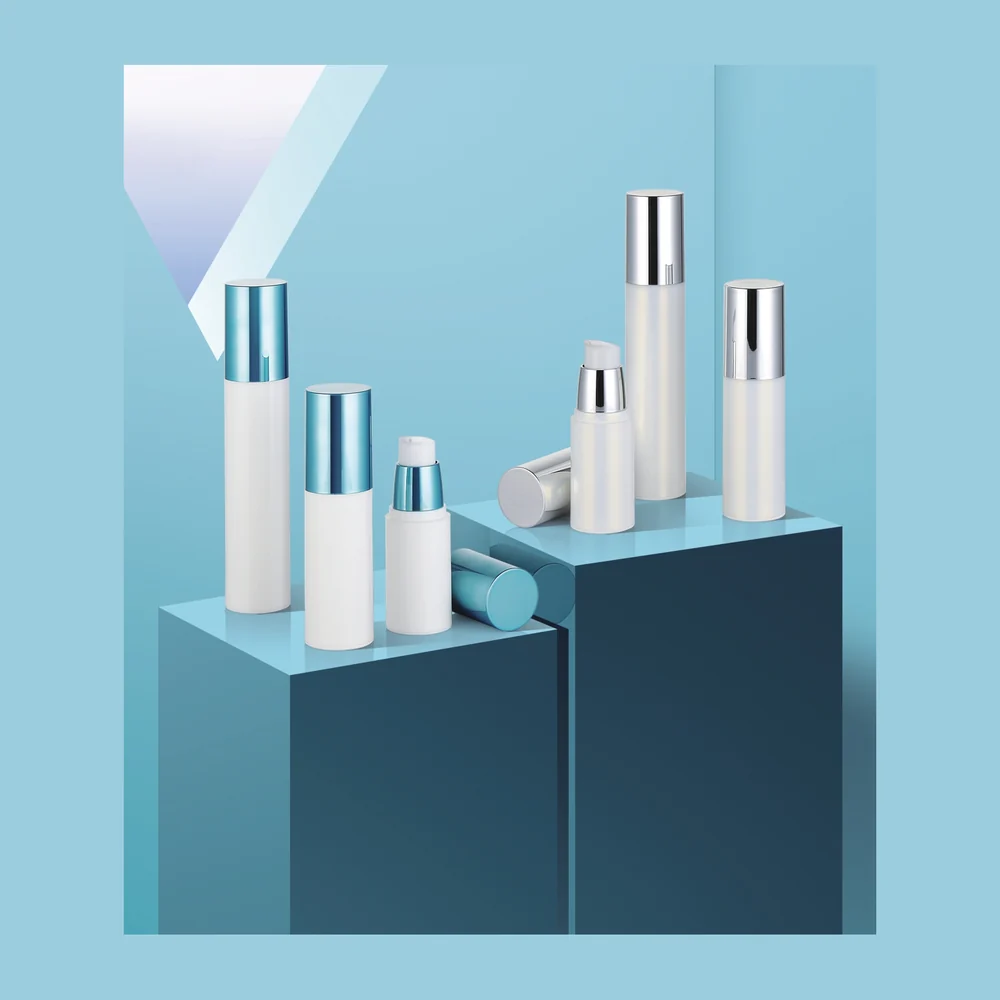
The source catalogue groups its airless range by mould. One entry is a bottle shape with a list of capacities underneath it, and each capacity has its own diameter and height printed beside it. Where a mould covers only one size, the entry has one line. Where it covers a family, the entry has several — and the page reproduces all of them in one card rather than splitting the family into separate formats. In this sense airless pump bottle capacity is published as a family, not as a single pack.
Across the 100 formats, the airless bottle sizes are unevenly distributed in a way that is worth knowing. Thirty-nine formats are printed with three capacities, seventeen with two, fourteen with five. Four formats carry four sizes, three carry six, and two carry eight. Twenty-one formats are single-size.
| Capacities printed per mould | Formats |
|---|---|
| 1 | 21 |
| 2 | 17 |
| 3 | 39 |
| 4 | 4 |
| 5 | 14 |
| 6 | 3 |
| 8 | 2 |
Airless bottle capacity, then, is not one figure per product. It is a list attached to a mould, and the list is the first thing to read when you are building a range rather than buying a single pack.
Sixty of the multi-size moulds keep one diameter
Of the 79 formats with more than one capacity, 60 keep the same maximum diameter across every size. What changes is the height. A tall slim airless bottle printed at Ø41.6 mm carries 60 ml at 133 mm, 80 ml at 151.5 mm and 100 ml at 168 mm. The silhouette is the same; the pack grows upward.
The other 19 multi-size formats change diameter as well as height, because the family steps between widths as it grows. Both patterns are normal, and the card tells you which one you are looking at: compare the diameter column across the sizes before assuming a family is a straight height change.
A shared diameter is useful for a product line because the label width, the shelf footprint and the carton's internal fit stay closer to constant. It is not a promise that every component is shared. The source prints the mould and the dimensions; it does not print which pump, collar or piston is common to every size. That is a question for the sample stage, and it should be asked explicitly.
What the larger families look like
The widest family in the collection runs from 30 to 200 ml under one entry — a spread of 170 ml across the same bottle shape. Others step from 30 to 150 ml, or 15 to 120 ml. At the other end, the smallest families add one size to a base format, which is often all a brief needs.
The cream jars follow the same pattern: 13 of the 16 jars are printed with more than one capacity, from 5 to 150 g across the range. The airless cream jar sizes therefore behave like the bottles — one entry, several fills. The airless bottles are the larger group — 78 formats, 64 of them multi-size — and the five lotion bottles and one dropper bottle sit at the end of the page as separate entries. If you are comparing cosmetic bottle mould sizes across the whole catalogue, this is the distinction that matters: a mould with one size and a mould with eight are different planning assets.
When you shortlist a family, take the smallest and the largest size and check both against your fill weight. A 30 ml bottle and a 200 ml bottle in the same family share a shape, not a fill line. The page states the capacity and the dimensions the source prints; it does not state the fill weight your formula will reach.
Which products suit a multi-size family
A family that spans 30–200 ml is useful for a line that changes size without changing shape: a face cream sold at 50 ml and 100 ml, a serum at 30 ml and 50 ml, a body product at 200 ml and 400 ml. The pack stays recognisable on shelf while the fill changes, and the label layout carries over.
It is less useful when the products differ in viscosity or in the pump they need. The card prints the mould and the dimensions; it does not print whether the pump, collar or piston is common across the sizes. A family that looks like one product line on the page can be two component sets in the sample room, and the buyer should ask which parts are shared before planning the range around it.
Three briefs where a multi-size family earns its place: a launch that wants a trial size beside the full size; a range that adds a larger pack without a new silhouette; a refill or travel programme that needs the same shape at a smaller fill. In each case the question is the same — which components are shared, and which are not. The answer decides whether the second size is a change part or a second project.
What to confirm before tooling
| Confirm | Why it changes the plan |
|---|---|
| Which capacities share one mould | It decides whether a second size needs a second tool or only a second set of change parts. |
| Whether the diameter is constant across the family | It decides label width, shelf fit and carton layout. |
| Which pump and collar are common to the sizes | The page prints the mould, not the component commonality. Ask before assuming one pump covers the range. |
| The fill weight each capacity reaches with your formula | Nominal capacity and usable fill are not the same number. |
| Whether the finish matches your filling line | A family can share a shape and still differ in the closure it takes. |
| A sample at the smallest and largest size | The proportions that look right on a card can feel wrong in the hand at either end. |
The practical use of a multi-size family is planning. You can put two or three capacities in a launch without commissioning a new shape for each, and you can test the market at the small size before committing to the large one. That is a planning advantage, not a cost guarantee: tooling, components and order quantity are confirmed project by project.
Where the figures come from
The 100 formats are published on the airless bottles and cream jars page and on the collection page, each card showing the capacities, diameters and heights the source prints, plus the material of every component. The size index lists the same formats by dimension. The counts in this article are taken from those published cards, so every figure can be checked against the page.
Every format in the collection is made to order. Order quantity is 5,000 pieces on the acrylic formats and 10,000–20,000 on the other bottles and jars, per format per colour; lower quantities for repeat customers can be discussed case by case and are not a standard offer. Sampling is free of charge with the international courier at the customer's cost. If airless bottle capacity is part of your brief, send the capacities you need and the fill weight behind each one. We will tell you which families cover them, and where a sample is the only way to confirm the proportions. Start an enquiry →