
Bottle Capacity Options: One Neck, Many Sizes in a 443-Format Catalogue
Some cosmetic packaging catalogues are organised by product. This one is organised by plate. Thirty-seven pages, twelve cells to a page, each cell a group photograph with three lines underneath: the product name, the neck, the capacity and the diameter. That is the whole specification. There is no material column and no height. One cell repeats on a second page, so the published count is 443 after de-duplication.
The cosmetic bottle range in the book is not 443 unrelated bottles. It is a smaller number of shapes, each offered in a ladder of capacities. Once you see that, the useful question changes from "which bottle do I like?" to "which neck do I build the range on?"
Bottle capacity options sit on a shared neck
One hundred and ninety-five of the 443 entries print more than one capacity. A single cell can read 250 / 300 / 500 / 600 / 650 / 800 / 1000 / 1200 ml against one neck and one diameter. The photograph in that cell shows several bottles of the same shape at different heights. The bottle capacity options are therefore choices within a family, not separate families.
The neck is the part that stays constant. The 24 mm neck appears on 157 of the 443 formats, and across those formats the printed capacities run from 20 ml to 500 ml. The 28 mm neck runs from 40 ml to 1000 ml. The 32 mm neck reaches 2000 ml.
| Neck (nominal) | Formats | Capacity span printed on that neck |
|---|---|---|
| 24 mm | 157 | 20–500 ml |
| 28 mm | 63 | 40–1000 ml |
| 20 mm | 47 | 15–200 ml |
| 32 mm | 29 | 80–2000 ml |
| 89 mm | 22 | 120–1200 ml |
| 43 mm | 16 | 15–900 ml |
| 68 mm | 14 | wide-mouth bottles and jars |
| No neck printed | 4 | — |
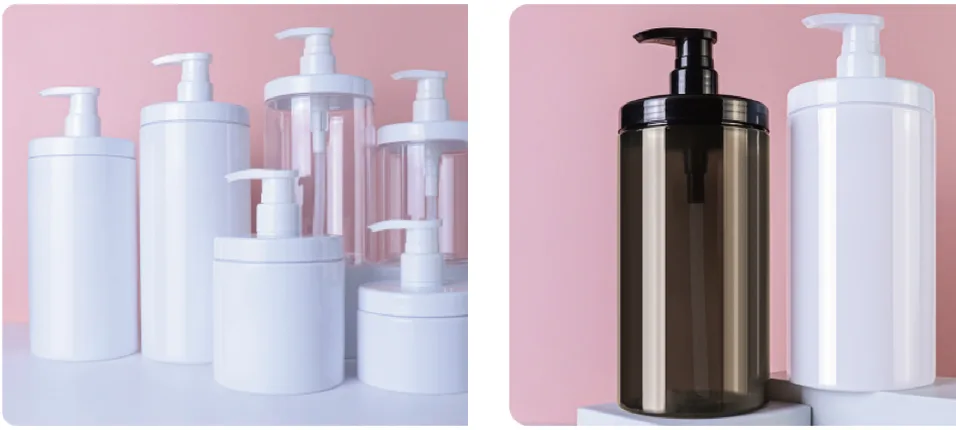
The plate page is a platform sheet
A plate is the factory's own way of saying "this mould, these sizes". The lotion bottle sizes in one cell are not separate products with separate tooling. They are the same body diameter and neck, run at different heights. That is why the cell can list eight capacities and still show one family in the photograph.
For a buyer, this is the most useful thing in the book. If you launch a 50 ml serum and later add a 100 ml size, staying on the same bottle neck platform means the cap, pump or dropper can stay in the same family. Changing the neck means a new closure, a new fit trial and possibly a new minimum quantity. The plate page lets you plan that before you commit.
It is also where a catalogue can mislead by omission. The printed neck is a nominal diameter. The source prints a tooth count (24, 28, 20); we publish that as the nominal diameter in millimetres, not as a thread specification. Two bottles that both say 24 mm may not accept the same pump without checking the thread, the pitch and the neck finish. The book does not print those, so the only safe next step is a sample and a fit test.
What the sheet does not print
None of the 443 entries carries a material. None carries a height. The source page prints the product name, the neck, the capacity and the diameter, and stops there. That is not unusual for a plate book: the plate is a shape and size reference, and material is often settled at quotation.
It does mean that four things you may need are absent from the page:
| Missing from the plate | Why it matters |
|---|---|
| Material | PET, PETG, PP and acrylic behave differently with your formula and your decoration. |
| Height and weight | Needed for carton fill, freight and shelf fit; the diameter alone does not give them. |
| Thread and neck finish | Nominal diameter is not proof that a closure will seal. |
| Order quantity and lead time | Commercial terms, not catalogue fields; they are confirmed per project. |
The right response is not to reject the book. It is to use it for what it does well, which is shape and size, and to put the missing four in the enquiry. A supplier who can answer them from the same family is more useful than a catalogue with more columns.
How to use a plate book in a brief
Start with the neck, not the photograph. Pick the closure you already use or intend to use, then find the plates that carry that neck. Within those plates, list the capacities you need now and the one or two you may add later. That gives you a family rather than a single bottle.
Then ask for the material, the height, the weight and the thread specification for the exact cells you shortlisted. Ask whether the decoration is applied to the same body across the size ladder, or whether each size is printed separately. And ask for a sample of the smallest and largest size in the ladder, because the same neck at 20 ml and 500 ml can feel like two different packs in the hand.
One caution on the 21 entries printed in grams. Those are jars and capsule bottles, and the figure is product weight, not volume. Do not compare a 50 g jar with a 50 ml bottle as if they were the same quantity. The catalogue prints the unit the factory uses for that part, and the two do not convert without a density.
How the counts were made
The formats are published on the bottles and jars page, each with the capacity, neck and diameter the source prints. The counts and spans above are taken from the 443 formats published on the bottles and jars page, so each figure can be checked against the catalogue.
The range comes from one manufacturing partner's catalogue, and every format in it is made to order. We quote per project rather than from a stock list, and order quantity is confirmed project by project. If you are choosing a bottle family, send the neck you want to standardise on, the capacities you need now and later, and the material your formula requires. We will tell you which plates fit, and where a sample is the only way to confirm the closure. Start an enquiry →