
Lip Gloss Capacity: OFC vs NET in a 608-Format Makeup Catalogue
Open a makeup catalogue at the lip gloss pages and a number such as OFC 10.7 ml sits under the tube. Turn to the lipstick pages and the same position reads NET 3.5 ml. Both are capacities. They are not the same measurement, and the difference is large enough to matter when you compare a quotation line by line.
This catalogue contains 608 makeup formats in six families. Of those, 484 print a capacity. The other 124 are applicator tips and palettes, where the source prints dimensions and material but no fill figure. Among the 484, the convention is not mixed inside a family. It changes at the family boundary.
Lip gloss capacity: one book, two definitions
| Family | Formats | Capacity printed | Convention | Median printed value |
|---|---|---|---|---|
| Lip gloss tubes | 167 | 167 | OFC (brim-full) | 8.0 ml |
| Mascara tubes | 108 | 108 | OFC (brim-full) | 12.6 ml |
| Tottle bottles | 78 | 78 | OFC (brim-full) | 36.0 ml |
| Lipstick cases | 131 | 131 | NET (product volume) | 3.8 ml |
| Applicator tips | 60 | 0 | no fill figure | — |
| Makeup palettes | 64 | 0 | no fill figure | — |
On the catalogue page we publish those conventions as brim-full capacity and net capacity, because those are the words a buyer can act on. OFC means the volume up to the rim. NET means the product volume the format is designed to hold. The catalogue prints one figure per format and does not print the headspace allowance between the two.
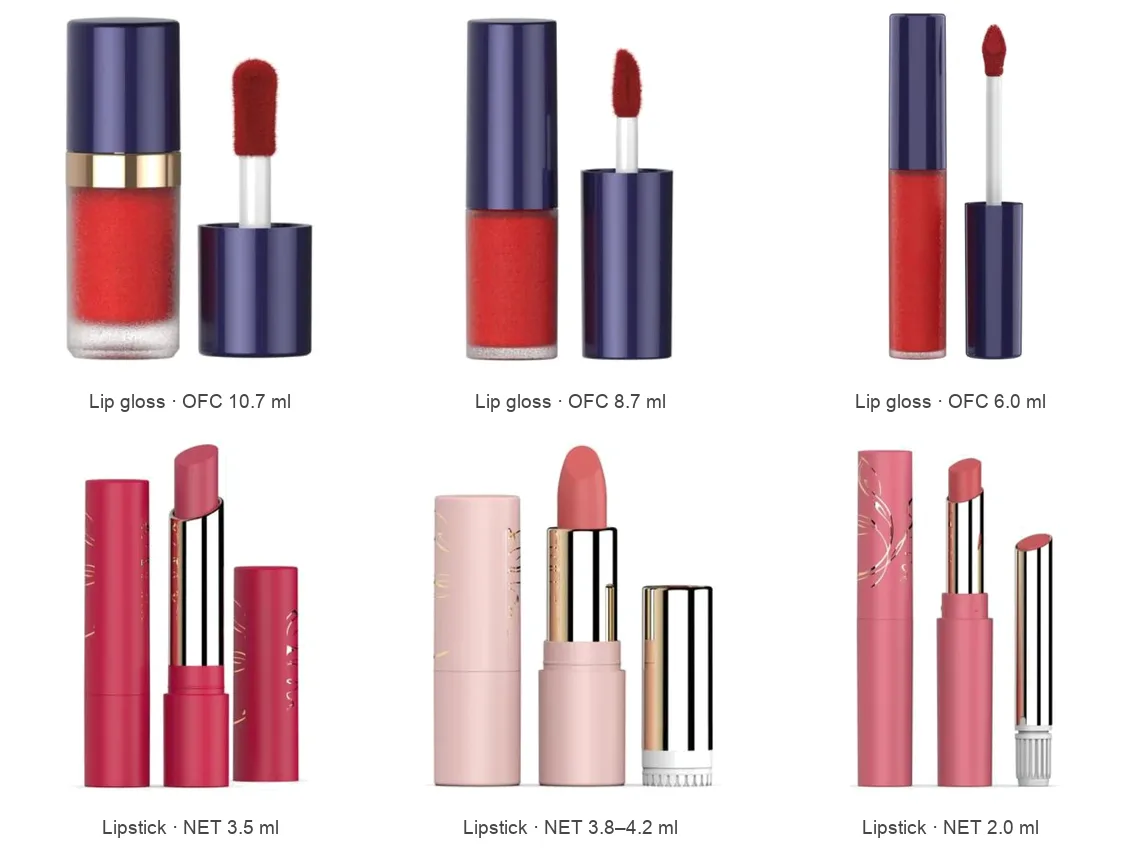
The pattern is consistent rather than random: all 167 gloss tubes, all 108 mascara tubes and all 78 tottle bottles are OFC; all 131 lipstick cases are NET. A buyer comparing a gloss with a lipstick is therefore comparing two different definitions, not two fill volumes.
What OFC includes that NET does not
A gloss tube is filled from the open end and wiped as the applicator is inserted. The pack has to leave room for the wiper, the stem and the headspace above the fill line. A lipstick is a solid column cast into a cup; its capacity is the product it is built to carry. In broad terms, the two families are filled by different methods, and the catalogue uses the convention that fits each one.
That is sensible for the catalogue's author and awkward for anyone comparing across families. A 10.7 ml gloss and a 10 ml net bottle do not necessarily hold the same amount of product. The gap depends on the wiper, the stem displacement and the fill height your line uses. None of those are printed, and the figure alone does not settle it. In cosmetic packaging capacity, the definition matters as much as the number.
The practical consequence is simple. If your brief says "10 ml" and the quotation comes back with "10.7 ml OFC", you have not yet established that the pack holds 10 ml of your formula. You have established the volume to the rim. Ask for the fill volume the supplier would run, and test it with your own product. The lipstick fill volume is printed as NET for the same reason: it is the product the case is built to carry.
Why the no-capacity formats are not a gap
The 124 formats without a capacity are not missing data. Applicator tips are components: they have a diameter and a length, but no reservoir. Palettes are a tray and a lid; the fill is the number of pans and the weight of each, which the source does not print. Publishing a capacity for either would mean inventing one, so we leave the field empty.
That distinction matters when you read a catalogue quickly. An empty capacity field can mean "not applicable", "not printed", or "not measured". In this book it means the first two. Ask which one applies before you assume a format is incomplete.
What to put in a capacity brief
| Ask for | Why it changes the answer |
|---|---|
| The definition behind the number: brim-full or net | Two formats with similar figures can differ by the headspace allowance. |
| The fill volume the supplier would actually run | It is the number your filling line and your label claim depend on. |
| Whether the figure is nominal or measured | A catalogue value is a design target, not a production mean. |
| A filling trial with your formula | Viscosity, wiper fit and temperature move the achievable fill. |
| The label claim you intend to print | Some markets regulate the declared quantity; the pack figure is not the label figure. |
There is no conversion we can give you from OFC to NET. The catalogue does not publish one, and a number invented here would be worse than no number. What we can do is tell you which formats in the range use which convention, and quote the fill trial that settles it for your product.
How to check the figures
All 608 formats are published on the makeup formats page, each with the capacity and the convention the source prints. The counts above are taken from the 608 formats published on the makeup formats page, so each figure can be checked against the catalogue. If you are comparing formats by size rather than fill, the same page lists diameter, width and height for every format.
These formats come from the catalogue of a manufacturing partner in our network. Everything in it is made to order, so a quotation follows the project rather than a stock list, and order quantity is confirmed project by project. If lip gloss capacity is part of your decision, send the fill volume, the formula type and the label claim you need. We will tell you which formats in the range can carry it and where a filling trial is the only way to know. Start an enquiry → If you want to see how a fill problem is caught before a lot ships, our inspection file includes the batches that were held back: read the file →