
Cosmetic Bottle Sizes: What 514 Formats Actually Use
There is no universal list of cosmetic bottle sizes. That is the first useful answer for a buyer, because a brief built on an assumed standard will come back with samples that do not match it. What a catalogue can do instead is show what exists inside one production range. Ours publishes 514 bottle and jar formats from a single manufacturing partner, and 483 of them print a capacity in millilitres. Those 483 use 32 different nominal values, from 5 ml to 800 ml — and the way they cluster is more useful than any single number.
The other 31 formats are not missing data in the same sense. Sixteen are jars whose capacity is printed in grams, and 15 print no capacity at all. This article counts millilitres only, states where the blanks are, and never turns a blank into a default.
The cosmetic bottle sizes this catalogue actually clusters around
Two figures decide most of the distribution: the band a format falls into, and the single value it repeats.
| Nominal capacity band | Formats | Share of the 483 |
|---|---|---|
| 20 ml and below | 44 | 9% |
| 21–100 ml | 225 | 47% |
| 101–300 ml | 171 | 35% |
| Above 300 ml | 43 | 9% |
Nearly half the range sits between 21 and 100 ml, and another third between 101 and 300 ml. The tails are real but thin: 44 formats at 20 ml or below, 43 above 300 ml. For a buyer, that means a small-format project has fewer comparable formats to choose between, not that small formats are unusual — only that this catalogue spreads its options more densely in the middle.
| Nominal capacity | Formats |
|---|---|
| 100 ml | 66 |
| 50 ml | 64 |
| 30 ml | 52 |
| 150 ml | 42 |
| 300 ml | 39 |
| 120 ml | 38 |
| 200 ml | 32 |
| 80 ml | 23 |
| 15 ml | 22 |
| 500 ml | 18 |
100 ml, 50 ml and 30 ml are the three most populated values in this catalogue. That is a statement about this range, not a market standard. It does mean that if your target fill is near one of those three, you are likely to have more shapes, neck options and closure pairings to compare than at 80 ml or 250 ml.
What a nominal capacity fixes — and what it leaves open
A nominal capacity fixes one thing: the volume the format is sold as. It does not fix the bottle's footprint, its height, its neck, its wall, or how much liquid it actually holds before it overflows. Those are separate fields, and the catalogue treats them separately.
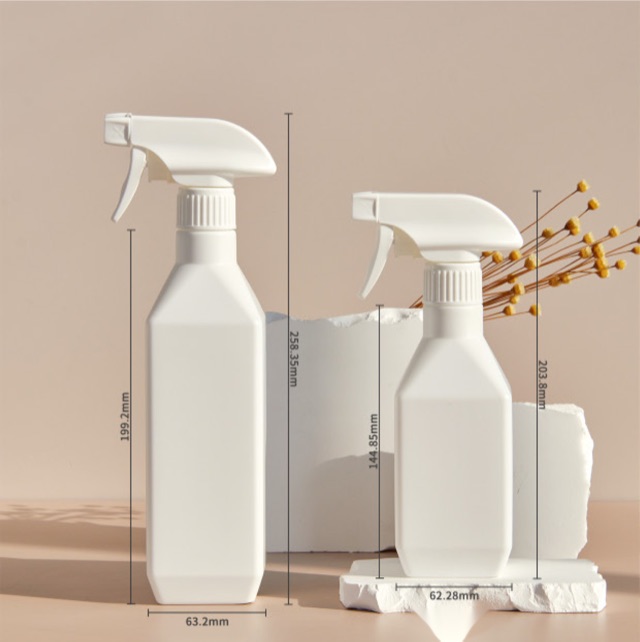
The clearest evidence is what happens inside a single capacity. Take 100 ml — the most populated value in the range. It covers 66 formats. Fifty-four of them print a size in the catalogue, and those 54 share only 46 distinct diameter × height strings between them — so most 100 ml formats that publish a size publish a different one.
| Nominal capacity | Formats | Print a size | Distinct size strings |
|---|---|---|---|
| 100 ml | 66 | 54 | 46 |
| 50 ml | 64 | 58 | 48 |
| 30 ml | 52 | 48 | 40 |
| 150 ml | 42 | 36 | 32 |
| 300 ml | 39 | 33 | 33 |
This is why two quotations for a "100 ml bottle" can describe genuinely different objects. One may be short and wide, the other tall and narrow. Both can be correct at 100 ml, and the difference matters for shelf presence, carton count, fill-line stability and how the bottle feels in the hand.

Cosmetic bottle dimensions and the brim-full question
A nominal capacity also does not answer "how much can it hold?". Most catalogue formats print only the nominal value. Thirty-five print a second figure in brackets: the brim-full volume. Across those 35, brim-full runs 5.6% to 28% above nominal, with a median of 11%.
| Nominal | Brim-full as printed | Difference |
|---|---|---|
| 30 ml | 36 ml | +20.0% |
| 50 ml | 57 ml | +14.0% |
| 100 ml | 111 ml | +11.0% |
| 150 ml | 160 ml | +6.7% |
| 240 ml | 261 ml | +8.8% |
| 300 ml | 342 ml | +14.0% |
The practical consequence is simple: if your fill volume is close to the nominal capacity, ask for the brim-full figure before approving a sample. A 100 ml bottle that overflows at 111 ml leaves 11 ml for headspace, the closure and any foaming. Whether that is enough depends on the product and the filling line, and it is not a question the capacity number can settle. Of the 483 millilitre formats, 448 print no brim-full value at all: they are not "tighter" or "looser" — the figure is simply unknown until measured on a sample.
A bottle brief that gets a comparable answer
The fastest way to make quotations comparable is to state the numbers that the capacity leaves open. This is the list we ask for, in the order that changes the answer most.
| Put this in the brief | Why it changes the format you are offered |
|---|---|
| Nominal fill volume | Selects the capacity band; state the product's declared volume, not the bottle's overflow volume. |
| Brim-full requirement, if any | Only 35 of these 483 formats print one; without a target, headspace is left to the sample. |
| Maximum height and footprint | The same capacity spans many diameter × height combinations; shelf, carton and filling-line limits decide among them. |
| Neck diameter and the closure you already have | Capacity does not fix the neck; the mating part is the constraint that matters most. |
| Material and appearance | Clear, translucent or coloured is a separate choice from size, and not every format is offered in every look. |
| Decoration area | Label or print area depends on the actual wall and curvature, which a nominal capacity does not describe. |
One caution belongs with the table: 15 of the 514 formats print no capacity and 16 print it in grams because they are jars. If a shortlist includes one of those rows, treat the missing millilitre value as unknown and ask, rather than converting grams to millilitres by assumption. Density varies by product, and a jar's gram figure is not a volume.
Where the numbers come from
All 514 formats are published on the bottles and jars page, each as a plate carrying the source dimensions. The counts above are recomputed from the public catalogue data by tools/formats_topic_facts.py capacity, so any figure in this article can be checked rather than taken on trust. The same catalogue supplies the neck-size distribution in our neck-size guide.
These formats come from the catalogue of a manufacturing partner in our network and are made to order — we quote per project rather than from a stock list, and order quantity is confirmed project by project. If you are choosing a cosmetic bottle size, send the fill volume, the brim-full target if you have one, your height and footprint limits, and the closure you intend to use. Those four lines will narrow 514 formats faster than any size chart. Start an enquiry → And if you want to see how a sample is checked against its stated dimensions before a lot ships, our inspection file includes the lots that were held back: read the file →