
Applicator Pen Packaging: One Mechanism, More Than Twenty Fills
Applicator pen packaging is a dispensing mechanism before it is a product category. The same body, the same twist or click action and the same tip can carry a cuticle oil, a lip gloss, a concealer, a nail treatment, or something that is not cosmetic at all. What changes between those products is the fill. What decides whether a given fill belongs in a pen is three mechanical questions — not the label on the container it came from.
The two charts below are a use map of the format: twenty-one fills we have seen specified into pen-format dispensers. They are a map of what the mechanism is asked to do. They are not a claim about what any of those products do, and they are not a list of formulations we make.
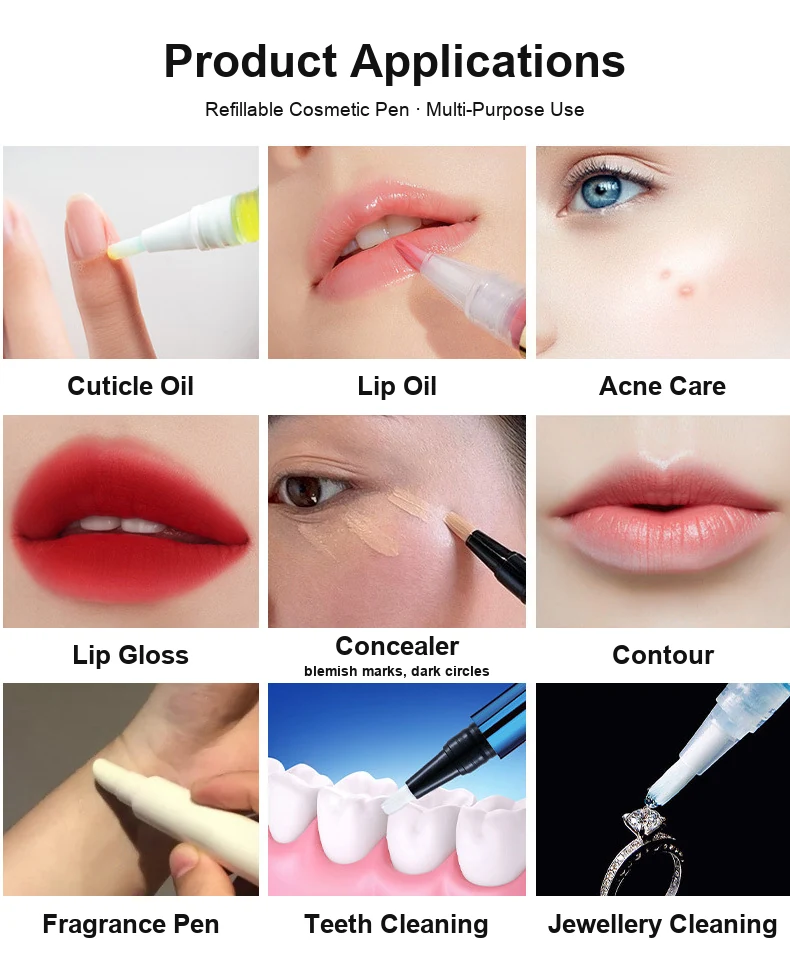
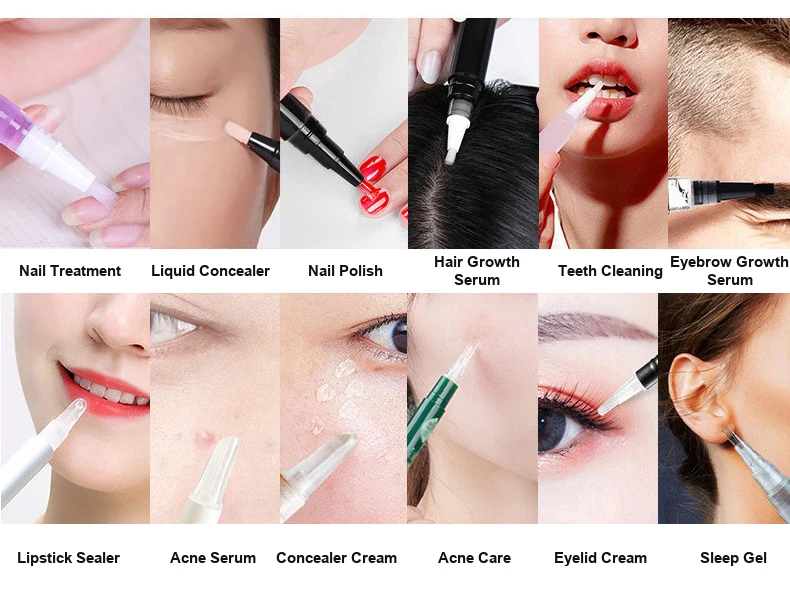
Read together, the maps make one point worth pausing on: only about a third of the fills shown are cosmetics in the narrow sense. Teeth cleaning, jewellery cleaning and sleep gel are not beauty products, and they are in the same chart as lip gloss because the container does not distinguish between them. A pen is a small reservoir with a controlled outlet. Whatever meets that description is a candidate.
What the use map is, and what it is not
Three things about these charts, stated plainly, because a chart of labelled product photos invites more inference than it supports.
They are a use map, not a specification. A fill appearing on this list means the pen format has been asked to carry it. It does not mean every pen model suits it, that the fill is stable in it, or that the result was satisfactory. Those are properties of a specific fill in a specific body, and neither is visible in a photograph.
They are not our formulations and not our claims. We do not make the liquids. We make the container, and the container's job is to deliver a dose and shut off cleanly. If a chart says a pen is used for an eyebrow serum, that is a statement about the market's habits. It is not a statement that a serum does anything.
They are not complete. Twenty-one entries is what a supplier's use chart typically shows. The mechanism does not have a twenty-one-item limit; it has the three constraints set out below. A fill that is not pictured here is not excluded — it simply has not been mapped. That is the right frame for applicator pen packaging in general: the format is defined by its constraints, not by a list of approved products.
Precision applicator pen: one body, many tips
The part of a pen that touches the product is the tip, and the tip is the most variable component in the whole format. Across our range, 48 of the 104 models carry a charted tip count in the source catalogue: 38 models chart 36 tip options, seven chart 15, and three chart four. The remaining 56 models — all 35 solid formats and all 10 auto-flow formats among them — have no tip chart to publish.
A precision applicator pen is therefore not usually a different pen. It is the same body fitted with a different tip: a fine brush for a liner, a slanted tip for a spot application, a flat disc for a spreading action, a hard nib for a gel. On the models that chart them, 36 options on a single body means one mechanism covers an unusually wide span of application behaviour before you need to change anything else.
This is also why “what tip does it come with” is a weak question and “which tip for this fill and this gesture” is the useful one. The body is chosen once. The tip is chosen against the fill.
A pen applicator for serum is not specified like one for a liner
A liner and a serum are both liquids in a pen, and they are bought on different numbers. A liner is usually specified against a line width and a depth of colour, at a fill volume small enough that 2 ml is the single most common capacity in our range — 16 of the 104 models, with 4 ml on 15 models and 3 ml on 10.
A pen applicator for serum is specified against how many doses the reservoir has to give, which is a different quantity from how much it holds. That distinction is where most pen briefs go wrong, and we have written about it separately: across all 104 models there is no per-model field for dose at all, because dose per actuation is a measured property of a mechanism plus a product, not a catalogue value.
The practical consequence is that a serum brief should arrive with a dose budget — how much per use, and how many uses — and let the capacity fall out of it. Arriving with a capacity and hoping the dose works out is the reverse order, and it is the order that produces a pen that is empty before the customer expects or still half full when the mechanism stops being pleasant to use.
Refillable cosmetic pen: how much the reservoir actually holds
“Refillable” in this format means the body has a reservoir that is filled during production, as opposed to a solid column that is consumed as it is used. The solid family is the contrast case, and it is a large one: 35 of our 104 models are solid, and the source charts a capacity for none of them. On a solid format the fill is the product, so a capacity figure would be a number without a meaning.
For the liquid families the published capacities run 1 to 10 ml, spread across 67 models that print one. Body sizes run from Ø6.63 mm to Ø30.0 mm and from 81.3 mm to 153.48 mm long, which is a wider spread than the capacity range suggests — a short, wide pen and a long, thin pen can hold the same fill and feel entirely different in the hand.
A refillable cosmetic pen brief should therefore carry two numbers, not one: the fill volume and the body length. The fill volume decides how long the product lasts. The body length decides whether it is carried like a pen or packed like a small bottle — and that second number is the one buyers forget, then rediscover when the carton is specified.
Twist pen packaging: metered by how far you turn
Twist pen packaging is the largest mechanism family in our range at 48 of 104 models across two sub-families — 37 liquid-twist and 11 special-twist. The action is continuous: product moves while the body turns, and stops when the user stops. There is no fixed step.
That has a real consequence for the fill. A continuous mechanism is forgiving of a thin liquid and less forgiving of a thick one, because the same turn displaces the same volume from the reservoir regardless of what is in it. Whether the tip receives what it needs depends on how the fill flows into the tip, and a fill that clings to the reservoir wall can leave a fraction behind that never reaches the outlet.
Twist also spreads widely in size, from a slim liner body to a substantially larger one, which is why “a twist pen” as a brief is close to meaningless without a size attached to it.
Click pen packaging: metered in discrete steps
Click pen packaging is the tightest family here: 11 models, and the whole family lives between Ø13.15 mm and Ø18.34 mm. A click mechanism delivers in discrete increments rather than continuously, so the user's experience is a series of defined amounts rather than a flow they modulate.
For a fill that suits discrete dosing, click is the mechanism that behaves most predictably, because the step is a property of the mechanism rather than of how long the user holds the body. The trade is that the user cannot fine-tune partway through a step — and on a mechanism that does not retract, a step that has been delivered has been delivered.
Both families, and the auto-flow and solid formats besides, are laid out side by side on the cosmetic pens page, and the mechanical differences between all five are set out in the five pen formats.
Pen packaging for gel: why a thicker fill changes the brief
Pen packaging for gel is where the three questions below stop being theoretical, because a gel resists flow in a way a thin liquid does not. A gel clings to the reservoir wall and can leave a fraction of the fill behind that never reaches the outlet. An auto-flow format depends on the fill moving to the outlet on its own; whether it does is a property of the product, not of the pen.
None of that is a reason to avoid the format, and gels are among the fills shown in the charts above. It is a reason to ask the mechanism question before the capacity question — because the capacity question has an answer printed on a catalogue page, and the mechanism question usually does not.
What we cannot answer about your fill
Three questions decide whether a fill belongs in a pen. Here is what a container supplier can honestly contribute to each, and what it cannot.
| Question | What we can supply | What we cannot |
|---|---|---|
| Dose per actuation | The mechanism family, the body geometry and the tip options — the inputs a fill trial starts from. | The number itself. It depends on the mechanism, the fill's flow behaviour and the fill level, and it changes as the reservoir empties. |
| Does the closure shut the flow path off | The component list, the assembly and whether the cap seals or simply covers. We can say what a given model does. | Whether that is sufficient for your product. Sufficiency follows from your formulation and your own requirements. |
| Which component touches the formulation | The material of every part. 70 of our 104 models are specified with no metal anywhere in the construction, which is the answer to one common constraint. | Whether a material is compatible with a specific formulation. That testing comes from the material suppliers and the laboratories. |
The pattern in that table is the same in all three rows: we can describe the container exactly and we cannot describe your product. We hold no pharmaceutical, medical-device or management-system certification, and we do not issue biocompatibility or extractables and leachables documentation. Whether a pen suits a regulated fill follows from the formulation and the buyer's own regulatory route, and those answers come from the material suppliers and the testing laboratories — not from a packaging supplier's own declaration.
If that puts work on your side, it is work that was always yours. A container supplier offering to close it for you is offering a document, not a result.
Using this when you brief
The sequence that works is short, and it is the reverse of the one most pen briefs arrive in.
Start from the dose: how much per use, and how many uses per unit. That turns into a reservoir volume, and the volume turns into a body size. Then pick the mechanism from how the user should experience the dose — continuous for a fill the user modulates, discrete for one that should arrive in defined steps. Then pick the tip against the gesture, from the options the charted models carry. Then check the body diameter against the cap, the label and the carton, because a few millimetres there is a different packaging line item further down.
Only the first step is yours alone. The other three we can answer from published data, model by model — and that split, between what is described and what is decided, is the part of applicator pen packaging a supplier can actually be held to. We will say plainly when a question falls outside it.
Every capacity, diameter, length, material and charted tip count behind this article is published family by family on the cosmetic pens page. If your fill is a gel, cream or other viscous product rather than a cosmetic liquid specifically, the dispenser article takes the same question across all three format families. Know the model you want? Put the model number in the quotation form and we will come back with a specification.