
How to Import Cosmetic Packaging from China (Step by Step)
Importing cosmetic packaging from China is safe and cost-effective when you lock four gates: screen the supplier, lock the sample, control the money, and inspect before shipping. Most failed imports — wrong material, missed deadlines, off-spec finish — trace back to skipping one of those four. Here's the step-by-step process, and the order matters.
Step 1 — Screen the Supplier
Ask three questions before you request a quote. Are you the factory or a trading company — and can you prove it with production-floor photos, machinery, and a video call? Who are your current buyers in my market — EU and US references mean you already know the compliance paperwork? And can you show a real inspection record, a masked report, not a promise? We've been a Shanghai factory since October 2005, so production evidence is easy to produce.
Step 2 — Get Samples and Lock the Specification
Never commit to mass production from pictures. Order a stock sample first (fast and cheap). For a custom design, request a prototype and lock a written specification — material, size, capacity, finish, decoration, artwork — that both sides sign. The sample is the contract; every bulk shipment is compared against it.
Step 3 — Understand MOQ and Price
Ask about MOQ and price together. Catalogue items whose tooling already exists carry no tooling cost; custom molding adds a one-time tool investment, with the order quantity confirmed per project. Get an itemized quote: unit price at your MOQ, tooling, packaging, freight. A low unit price with hidden tooling isn't a discount.
Step 4 — Choose Fair Payment Terms
Standard practice is 30% deposit to start production, 70% balance before shipment. Be wary of anyone asking for 100% up front. For large first orders, consider escrow or a letter of credit. Keep all negotiation in writing, in one thread.
Step 5 — Approve the Pre-Production Sample
Before mass production, the supplier should produce a pre-production (golden) sample carrying your exact decoration and colors. This is your last chance to change anything without cost. Approve it in writing — by email, not by voice.
Step 6 — Run QC Inspection
Inspection is where importers protect their money. Professional factories inspect in three stages — during production, final, and pre-shipment — using AQL sampling (ANSI/ASQ Z1.4). Ask for the inspection report before the container leaves.
Why Inspection Is Non-Negotiable
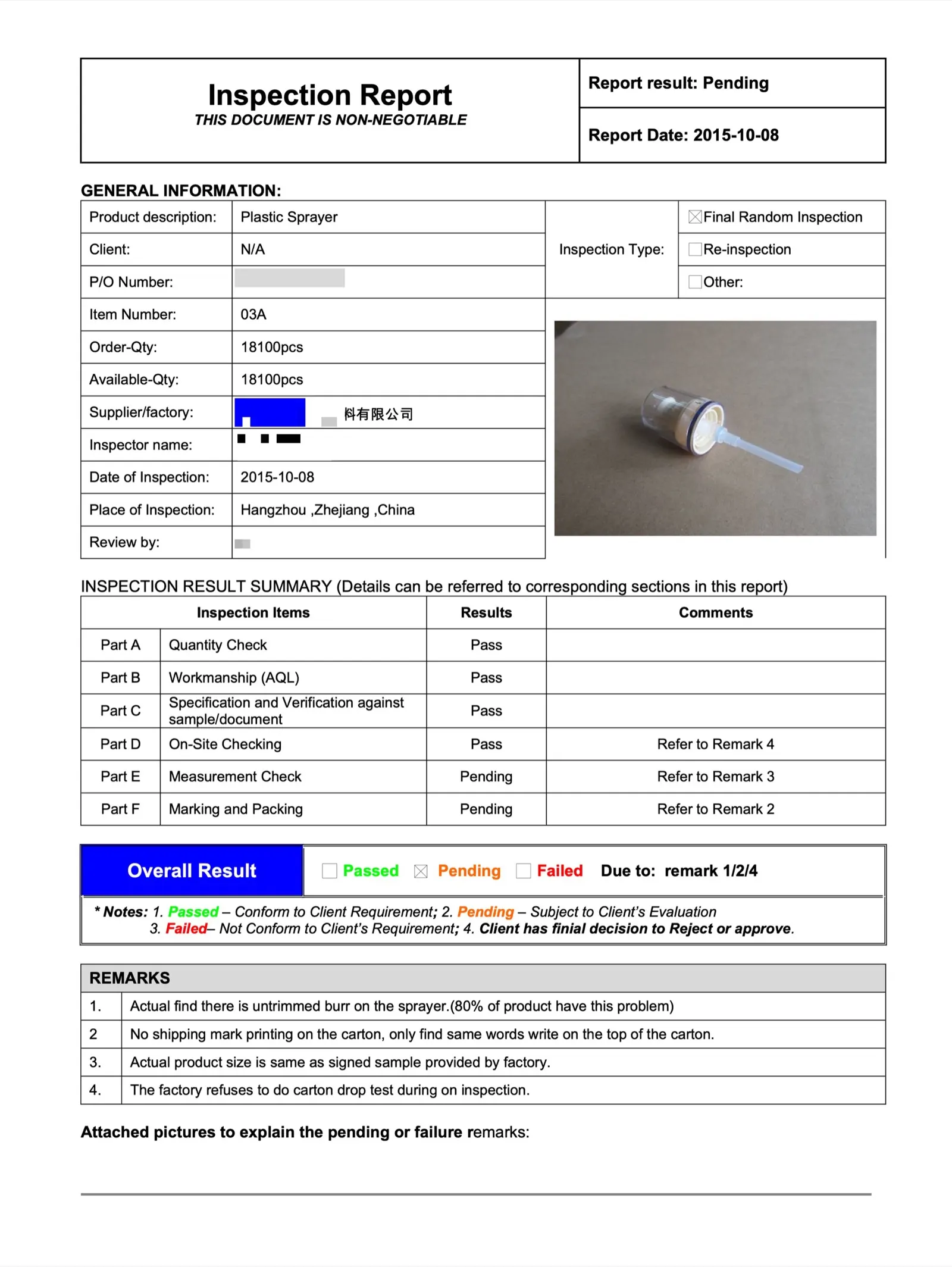
Here's why inspection isn't a formality. This is a real report from our archive — a flagged one, which is exactly why we publish these: 80% of sampled sprayers had untrimmed burrs, the result was marked Pending, and rework was required before release. Defects caught at the factory cost a fraction of defects found in your warehouse.
| Year | Order | Quantity | Verdict | Result |
|---|---|---|---|---|
| 2015 | Plastic Sprayer | 18,100 pcs | FLAGGED | 80% of sampled sprayers had untrimmed burrs. Marked Pending; factory required to rework before release. |
Report pages from our inspection archive:
Step 7 — Arrange Shipping and Customs
Choose the Incoterm up front — FOB, CIF, or DDP for first-time buyers who want less friction. Confirm the supplier ships with established carriers (we use established freight partners) and that compliance documents for your market ride with the order.
What Ships With Your Order
Every order should ship as a specified, inspected product like this one:
Want the exact import checklist as a working document?
Download our free sourcing guide, or send us your product idea for a quote within 24 hours.