
EU PPWR 2026: A Practical Compliance Checklist for Beauty Brands
EU PPWR core obligations are already in force — they became directly applicable across all member states on 12 August 2026, and if your packaging isn't documented yet, you're late. From that date, every packaging item you place on the EU market needs a Declaration of Conformity, a recyclability assessment, and PCR documentation. This is the practical checklist: what changed, what's coming in 2030, and what documents your supplier must hold.
What Changed on 12 August 2026
PPWR (Regulation (EU) 2025/40) applies directly in all member states — no national transposition, no per-country grace period. The core obligations now live: a Declaration of Conformity for every packaging item, a recyclability assessment, PCR (recycled-content) documentation, packaging minimization, and EPR registration in each country of sale. Cosmetics packaging counts as contact-sensitive plastic packaging, which faces stricter requirements. If a supplier can't produce these documents, that's a red flag before you order.
2030 Deadlines to Plan For Now
The 12 August 2026 date is the starting gun, not the finish line. By 1 January 2030: most plastic packaging needs 35% PCR content (contact-sensitive PET 30%, other contact plastics 10%), every item must meet a Design for Recycling grade of C or higher, large retailers must offer refill stations, and hotel miniatures are banned. By 2038 only DfR grades A and B can be placed on the market. The real risk arrives before the deadlines: certified food-grade rPET and rPP are supply-constrained, so brands that delay locking material until 2027 face redesign costs and bottlenecks.
Mono-Material Is the Safe Zone
The high-risk zone under PPWR is multi-material, non-separable packaging — for example a PET bottle with an ABS decorative ring and a metal-spring pump. That combination typically scores D or E for recyclability and becomes unmarketable after 2030. The safe route is mono-material design: ≥95% single polymer, PP springs replacing metal springs, metallic-effect molded plastic replacing collars, and labels made from the same polymer as the body. See what we offer on our sustainable packaging page and our materials guide.
Documentation You Must Hold
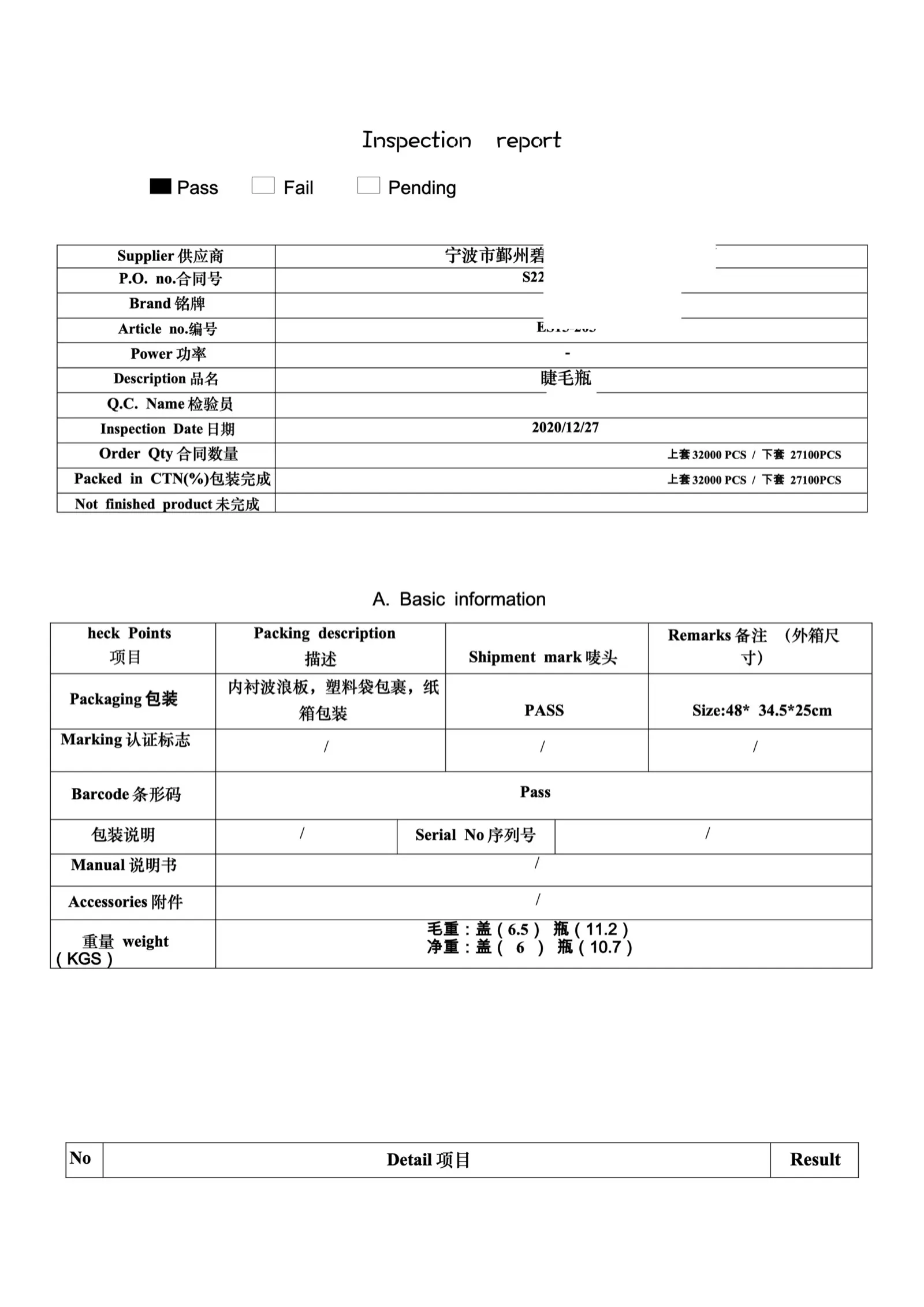
From August 2026, the documents that matter are: the Declaration of Conformity, the recyclability assessment, mass balance certificates for PCR content, and material data sheets. The quality of that documentation is something you can test — a bilingual inspection report, like the real one below from a 2020 mascara bottle order, is the kind of paper trail we keep on every order.
Documentation in Practice: A Real Report
| Year | Order | Quantity | Verdict | Result |
|---|---|---|---|---|
| 2020 | Mascara Bottle | — | PASSED | Recent mascara bottle order inspected with a bilingual (EN/CN) report; quantity, workmanship, dimensions and packing verified. |
Report pages from our inspection archive:
What JUMBO Provides
To meet that documentation bar, ask whether a supplier runs a certified quality system and inspects to a recognized standard:
- Aql Standard: ANSI/ASQ Z1.4 (MIL-STD-105E) Level II, single normal sampling
- MOQ: Confirmed per project
Need PPWR-ready packaging for 2026?
Ask about our PCR and mono-material options and the documentation we provide on every order.